Interview: Anna Tahinci
Longtime WIH Art History professor Anna Tahinci, Ph.D., will teach a six-part series called “Masters and Masterpieces” this fall. She graciously agreed to answers a few questions about her upcoming class.
WIH: The term “masterpiece” can be subjective. How do you define it for the purposes of this class?
AT: The word “masterstik” was first recorded in English in 1579 in a set of guild regulations in Aberdeen. Historically, an apprentice was trained by a “master” and would produce a “masterpiece” (a work of very high standards and skills) in order to obtain full membership in a guild. Today the word “masterpiece” means a creation of outstanding artistry and workmanship and we will develop our own criteria in establishing why and how an artwork qualifies as a “masterpiece”.
WIH: Your course spans from the Renaissance to the modern era. How did you choose these six artists as representative “masters” of their time?
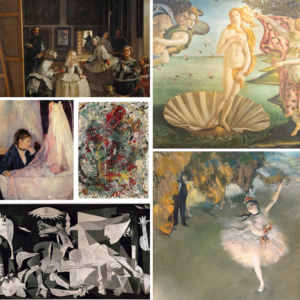
AT: This was not an easy choice and, as with all choices, some of the challenges resided in masters I had to eliminate to come up with my final selection. I ultimately chose Sandro Botticelli, Diego Velázquez, Edgar Degas, Berthe Morisot, Pablo Picasso, and Jackson Pollock in order to connect the dots between past innovations and contemporary relevance.
WIH: When looking at artists as different as Botticelli and Pollock, what common threads do you see in their work that make it timeless?
AT: Powerful and poignant art is both timely and timeless. All six artists share an innovative spirit, a willingness to defy established norms, and an ability to reflect on the human experience through art.
WIH: Do you think the concept of the “masterpiece” still has meaning in an age of digital media and mass production?
AT: Studying masterpieces in our 21st century takes us on a journey in time and self-discovery, so that we can better understand our world and ourselves. In an age of speed and greed it is meaningful to practice pace and grace and to learn from masters and their creative problem solving.
WIH: If students walk away from your course with a single new way of looking at art, what do you hope it will be?
AT: I teach Art History as a quest for multi-layered meaning and I encourage multiple viewpoints. I hope my students walk away from our course with a deeper appreciation for the power of art across the ages.
Thank you so much and I look forward to a great Fall semester and to seeing you soon!
Anna